





American Business History: A Very Short Introduction
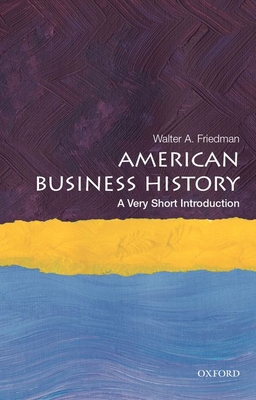
American Business History: A Very Short Introduction
By the early twentieth century, it became common to describe the United States as a "business civilization." President Coolidge in 1925 said, "The chief business of the American people is business." More recently, historian Sven Beckert characterized Henry Ford's massive manufactory as the
embodiment of America: "While Athens had its Parthenon and Rome its Colosseum, the United States had its River Rouge Factory in Detroit..." How did business come to assume such power and cultural centrality in America? This volume explores the variety of business enterprise in the United States and analyzes its presence in the country's economy, its evolution over time, and its meaning in society. It introduces readers to formative business leaders (including Elbert Gary, Harlow Curtice, and Mary Kay Ash), leading
firms (Mellon Bank, National Cash Register, Xerox), and fiction about business people (The Octopus, Babbitt, The Man in the Grey Flannel Suit). It also discusses Alfred Chandler, Joseph Schumpeter, Mira Wilkins, and others who made significant contributions to understanding of America's business
history. This VSI pursues its three central themes - the evolution, scale, and culture of American business - in a chronological framework stretching from the American Revolution to today. The first theme is evolution: How has U.S. business evolved over time? How have American companies competed with one another and with foreign firms? Why have ideas about strategy and management changed? Why did business people in the mid-twentieth century celebrate an "organizational" culture
promising long-term employment in the same company, while a few decades later entrepreneurship was prized? Second is scale: Why did business assume such enormous scale in the United States? Was the rise of gigantic corporations due to the industriousness of its population, or natural resources, or government policies? And third, culture: What are the characteristics of a "business civilization"? How have opinions on the meaning of business changed? In the late nineteenth century, Andrew Carnegie believed that America's numerous enterprises represented an exuberant "triumph of democracy." After World War II,
however, sociologist William H. Whyte saw business culture as stultifying, and historian Richard Hofstadter wrote, "Once great men created fortunes; today a great system creates fortunate men." How did changes in the nature of business affect popular views? Walter A. Friedm
PRP: 80.54 Lei

Acesta este Prețul Recomandat de Producător. Prețul de vânzare al produsului este afișat mai jos.
72.49Lei
72.49Lei
80.54 LeiPrimești 72 puncte
Livrare in 2-4 saptamani
Descrierea produsului
By the early twentieth century, it became common to describe the United States as a "business civilization." President Coolidge in 1925 said, "The chief business of the American people is business." More recently, historian Sven Beckert characterized Henry Ford's massive manufactory as the
embodiment of America: "While Athens had its Parthenon and Rome its Colosseum, the United States had its River Rouge Factory in Detroit..." How did business come to assume such power and cultural centrality in America? This volume explores the variety of business enterprise in the United States and analyzes its presence in the country's economy, its evolution over time, and its meaning in society. It introduces readers to formative business leaders (including Elbert Gary, Harlow Curtice, and Mary Kay Ash), leading
firms (Mellon Bank, National Cash Register, Xerox), and fiction about business people (The Octopus, Babbitt, The Man in the Grey Flannel Suit). It also discusses Alfred Chandler, Joseph Schumpeter, Mira Wilkins, and others who made significant contributions to understanding of America's business
history. This VSI pursues its three central themes - the evolution, scale, and culture of American business - in a chronological framework stretching from the American Revolution to today. The first theme is evolution: How has U.S. business evolved over time? How have American companies competed with one another and with foreign firms? Why have ideas about strategy and management changed? Why did business people in the mid-twentieth century celebrate an "organizational" culture
promising long-term employment in the same company, while a few decades later entrepreneurship was prized? Second is scale: Why did business assume such enormous scale in the United States? Was the rise of gigantic corporations due to the industriousness of its population, or natural resources, or government policies? And third, culture: What are the characteristics of a "business civilization"? How have opinions on the meaning of business changed? In the late nineteenth century, Andrew Carnegie believed that America's numerous enterprises represented an exuberant "triumph of democracy." After World War II,
however, sociologist William H. Whyte saw business culture as stultifying, and historian Richard Hofstadter wrote, "Once great men created fortunes; today a great system creates fortunate men." How did changes in the nature of business affect popular views? Walter A. Friedm
Detaliile produsului



