







American Philosophy and Rudolf Steiner: Emerson - Thoreau - Peirce - James - Royce - Dewey - Whitehead - Feminism
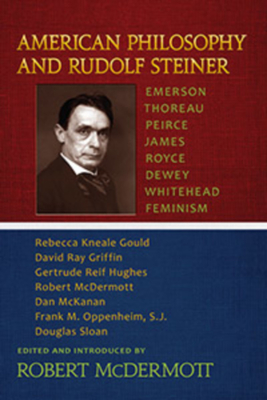
American Philosophy and Rudolf Steiner: Emerson - Thoreau - Peirce - James - Royce - Dewey - Whitehead - Feminism
"Few thinkers from outside the United States have touched American culture in as many ways as Rudolf Steiner. Agriculture, education, spirituality, and medicine-or more precisely, alternative practices in these fields-all bear clear marks of his influence, for those with eyes to see. Yet the very breadth of Steiner's impact has perhaps made him harder, not easier, for observers of American culture to notice. The terms Waldorf education and biodynamic agriculture are more widely recognized than Rudolf Steiner himself or Anthroposophy. Anthroposophic initiatives are commonly understood in relation to parallel initiatives with different spiritual roots, rather than in relation to the rich fabric of Steiner's worldview. Americans typically imagine biodynamic agriculture as a more intense form of organics and Waldorf schools as "like Montessori schools only more so." When I describe the Camphill movement, most interlocutors respond with "Is that like the L'arche movement?" And thousands of shoppers at health food cooperatives and Whole Foods supermarkets purchase Weleda skin lotion, diaper cream, or homeopathic remedies with little sense of connection to Steiner's vision of spirit active in the world." -Dan McKanan (from the foreword) American Philosophy and Rudolf Steiner aspires to raise Steiner's profile by digging into just one field of inquiry: philosophy. Before he became known to the world as a transmitter of clairvoyant wisdom, Steiner was an academic philosopher, editor of the scientific writings of Goethe and author of a foundational work in philosophy, The Philosophy of Freedom: The Basis for a Modern Worldview, published in 1894. That book expressed in philosophical terms many of the ideas that would later emerge as integral to the spiritual science of Anthroposophy. Though the authors cover a wide range of topics, most share an elegiac tone. They see great potential for dialogue between Rudolf Steiner and the great American philosophers of the nineteenth and early twentieth centuries. American philosophy may have taken a wrong turn in the mid-twentieth century, when pragmatism gave way to a tradition of analytical philosophy that eschewed metaphysics as inherently meaningless and focused on the coherence or incoherence of linguistic structures. Nonetheless, many new sites of potential dialogue exist between Steiner and American philosophy. Five of the articles in this volume were written as part of a seminar on Rudolf Steiner and American Thoug
PRP: 231.47 Lei

Acesta este Prețul Recomandat de Producător. Prețul de vânzare al produsului este afișat mai jos.
208.32Lei
208.32Lei
231.47 LeiPrimești 208 puncte
Indisponibil
Descrierea produsului
"Few thinkers from outside the United States have touched American culture in as many ways as Rudolf Steiner. Agriculture, education, spirituality, and medicine-or more precisely, alternative practices in these fields-all bear clear marks of his influence, for those with eyes to see. Yet the very breadth of Steiner's impact has perhaps made him harder, not easier, for observers of American culture to notice. The terms Waldorf education and biodynamic agriculture are more widely recognized than Rudolf Steiner himself or Anthroposophy. Anthroposophic initiatives are commonly understood in relation to parallel initiatives with different spiritual roots, rather than in relation to the rich fabric of Steiner's worldview. Americans typically imagine biodynamic agriculture as a more intense form of organics and Waldorf schools as "like Montessori schools only more so." When I describe the Camphill movement, most interlocutors respond with "Is that like the L'arche movement?" And thousands of shoppers at health food cooperatives and Whole Foods supermarkets purchase Weleda skin lotion, diaper cream, or homeopathic remedies with little sense of connection to Steiner's vision of spirit active in the world." -Dan McKanan (from the foreword) American Philosophy and Rudolf Steiner aspires to raise Steiner's profile by digging into just one field of inquiry: philosophy. Before he became known to the world as a transmitter of clairvoyant wisdom, Steiner was an academic philosopher, editor of the scientific writings of Goethe and author of a foundational work in philosophy, The Philosophy of Freedom: The Basis for a Modern Worldview, published in 1894. That book expressed in philosophical terms many of the ideas that would later emerge as integral to the spiritual science of Anthroposophy. Though the authors cover a wide range of topics, most share an elegiac tone. They see great potential for dialogue between Rudolf Steiner and the great American philosophers of the nineteenth and early twentieth centuries. American philosophy may have taken a wrong turn in the mid-twentieth century, when pragmatism gave way to a tradition of analytical philosophy that eschewed metaphysics as inherently meaningless and focused on the coherence or incoherence of linguistic structures. Nonetheless, many new sites of potential dialogue exist between Steiner and American philosophy. Five of the articles in this volume were written as part of a seminar on Rudolf Steiner and American Thoug
Detaliile produsului



