





Battle for the Bocage, Normandy 1944: Point 103, Tilly-Sur-Seulles and Villers Bocage
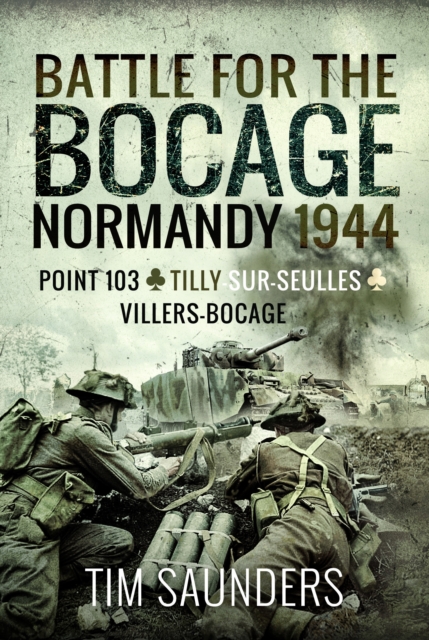
Battle for the Bocage, Normandy 1944: Point 103, Tilly-Sur-Seulles and Villers Bocage
"Ariel photographs and maps take you through the advances and retreats of those involved, and even provide drawings of defensive positions encountered by Allied forces, resulting in a well rounded and enjoyable read with text broken up by well chosen and located images." -- Armorama
This is the story of the fighting in Normandy by the veteran desert formations brought back by Montgomery from the Mediterranean in order to spearhead the invasion; 50th Infantry and 7th Armored divisions, plus 4th Armored Brigade. Heavily reinforced by individuals and fresh units, their task beyond the beaches was to push south to Villers Bocage with armor on the evening of D Day in order to disrupt German counter-attacks on the beachhead.
Difficulties on 50th Division's beaches and lost opportunities allowed time for the 12th Hitlerjugend SS Panzer Division and the equally elite 130th Panzer Lehr Division to arrive in Normandy, despite delays of their own caused by allied fighter bombers. The result was 4th Armored Brigade's thrust south encountered opposition from the start and was firmly blocked just south of Point 103 after an advance of less than 5 miles.
A major counter-attack by Panzer Lehr failed, as did a renewed British attempt, this time by the vaunted 7th Armored Division, which was halted at Tilly sur Seulles. From here the fighting became a progressively attritional struggle in the hedgerows of the Bocage country south of Bayeux. More and more units were drawn into the fighting, which steadily extended west. Finally, an opportunity, via the Caumont Gap, to outflank the German defenses was taken and 7th Armored Division reached Villers Bocage. Here the County of London Yeomanry encountered the newly arrived Tigers of Michael Wittmann, with disastrous results. The Desert Rats were forced to withdraw having lost much of their reputation.
There then followed what the battalions of 50th Division describe as their 'most unpleasant period of the war', in bitter fighting, at often very close quarters, for the 'next hedgerow'.
This is the story of the fighting in Normandy by the veteran desert formations brought back by Montgomery from the Mediterranean in order to spearhead the invasion; 50th Infantry and 7th Armored divisions, plus 4th Armored Brigade. Heavily reinforced by individuals and fresh units, their task beyond the beaches was to push south to Villers Bocage with armor on the evening of D Day in order to disrupt German counter-attacks on the beachhead.
Difficulties on 50th Division's beaches and lost opportunities allowed time for the 12th Hitlerjugend SS Panzer Division and the equally elite 130th Panzer Lehr Division to arrive in Normandy, despite delays of their own caused by allied fighter bombers. The result was 4th Armored Brigade's thrust south encountered opposition from the start and was firmly blocked just south of Point 103 after an advance of less than 5 miles.
A major counter-attack by Panzer Lehr failed, as did a renewed British attempt, this time by the vaunted 7th Armored Division, which was halted at Tilly sur Seulles. From here the fighting became a progressively attritional struggle in the hedgerows of the Bocage country south of Bayeux. More and more units were drawn into the fighting, which steadily extended west. Finally, an opportunity, via the Caumont Gap, to outflank the German defenses was taken and 7th Armored Division reached Villers Bocage. Here the County of London Yeomanry encountered the newly arrived Tigers of Michael Wittmann, with disastrous results. The Desert Rats were forced to withdraw having lost much of their reputation.
There then followed what the battalions of 50th Division describe as their 'most unpleasant period of the war', in bitter fighting, at often very close quarters, for the 'next hedgerow'.
PRP: 136.73 Lei

Acesta este Prețul Recomandat de Producător. Prețul de vânzare al produsului este afișat mai jos.
123.06Lei
123.06Lei
136.73 LeiPrimești 123 puncte
Livrare in 2-4 saptamani
Descrierea produsului
"Ariel photographs and maps take you through the advances and retreats of those involved, and even provide drawings of defensive positions encountered by Allied forces, resulting in a well rounded and enjoyable read with text broken up by well chosen and located images." -- Armorama
This is the story of the fighting in Normandy by the veteran desert formations brought back by Montgomery from the Mediterranean in order to spearhead the invasion; 50th Infantry and 7th Armored divisions, plus 4th Armored Brigade. Heavily reinforced by individuals and fresh units, their task beyond the beaches was to push south to Villers Bocage with armor on the evening of D Day in order to disrupt German counter-attacks on the beachhead.
Difficulties on 50th Division's beaches and lost opportunities allowed time for the 12th Hitlerjugend SS Panzer Division and the equally elite 130th Panzer Lehr Division to arrive in Normandy, despite delays of their own caused by allied fighter bombers. The result was 4th Armored Brigade's thrust south encountered opposition from the start and was firmly blocked just south of Point 103 after an advance of less than 5 miles.
A major counter-attack by Panzer Lehr failed, as did a renewed British attempt, this time by the vaunted 7th Armored Division, which was halted at Tilly sur Seulles. From here the fighting became a progressively attritional struggle in the hedgerows of the Bocage country south of Bayeux. More and more units were drawn into the fighting, which steadily extended west. Finally, an opportunity, via the Caumont Gap, to outflank the German defenses was taken and 7th Armored Division reached Villers Bocage. Here the County of London Yeomanry encountered the newly arrived Tigers of Michael Wittmann, with disastrous results. The Desert Rats were forced to withdraw having lost much of their reputation.
There then followed what the battalions of 50th Division describe as their 'most unpleasant period of the war', in bitter fighting, at often very close quarters, for the 'next hedgerow'.
This is the story of the fighting in Normandy by the veteran desert formations brought back by Montgomery from the Mediterranean in order to spearhead the invasion; 50th Infantry and 7th Armored divisions, plus 4th Armored Brigade. Heavily reinforced by individuals and fresh units, their task beyond the beaches was to push south to Villers Bocage with armor on the evening of D Day in order to disrupt German counter-attacks on the beachhead.
Difficulties on 50th Division's beaches and lost opportunities allowed time for the 12th Hitlerjugend SS Panzer Division and the equally elite 130th Panzer Lehr Division to arrive in Normandy, despite delays of their own caused by allied fighter bombers. The result was 4th Armored Brigade's thrust south encountered opposition from the start and was firmly blocked just south of Point 103 after an advance of less than 5 miles.
A major counter-attack by Panzer Lehr failed, as did a renewed British attempt, this time by the vaunted 7th Armored Division, which was halted at Tilly sur Seulles. From here the fighting became a progressively attritional struggle in the hedgerows of the Bocage country south of Bayeux. More and more units were drawn into the fighting, which steadily extended west. Finally, an opportunity, via the Caumont Gap, to outflank the German defenses was taken and 7th Armored Division reached Villers Bocage. Here the County of London Yeomanry encountered the newly arrived Tigers of Michael Wittmann, with disastrous results. The Desert Rats were forced to withdraw having lost much of their reputation.
There then followed what the battalions of 50th Division describe as their 'most unpleasant period of the war', in bitter fighting, at often very close quarters, for the 'next hedgerow'.
Detaliile produsului



