





Battleship Victory: Principles of Sea Power in the War in the Pacific
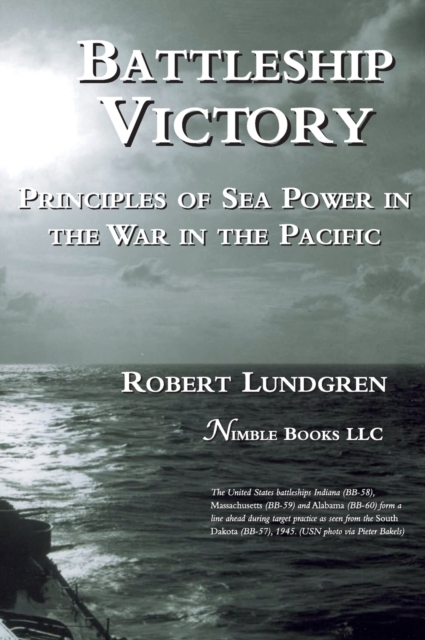
Battleship Victory: Principles of Sea Power in the War in the Pacific
Almost seventy-five years after the Japanese sank six US battleships at Pearl Harbor, Historian Robert Lundgren provides a startling reassessment of the role of battleships in World War II. Far from "being made obsolete in a single day", Lundgren upends the conventional wisdom by showing that the battle line was an essential tool for the exercise of seapower all the way to V-J Day. Indeed, he argues, the Japanese Navy's undue reliance on aircraft carriers alone was a key factor in its loss of command of the sea. From the introduction: "Human perception is human reality and I offer a different perspective on battleships by applying the principles of several naval and military thinkers, including Alfred Thayer Mahan and Julian Corbett that may change the perception that battleships became obsolete? By the end of the World War Two the aircraft carrier had replaced the battleship as the reigning queen of the seas. No new battleships designs were created leaving the last four Iowa class battleships to be the last of their kind to serve the United States. What role did battleships, aircraft carriers, cruisers, and submarines play in the United States victory and Japan's defeat during the Second World War? I will argue here that, contrary to conventional wisdom, battleships continued to play a decisive role throughout the war." Through a meticulous examination of the operational details of every major battle in the War in the Pacific, Lundgren illuminates how the US prevailed with a "combined arms" approach that made use of all the particular capabilities of aircraft carriers, battleships, and submarines. Only in this way could a navy follow the fundamental principles of sea power identified by Mahan and Corbett. This is a must read for anyone who thinks they know the history of the War in the Pacific. A wonderful gift that will spark many debates among battleship and naval aviation enthusiasts alike. Robert Lundgren is also the author of The World Wonder'd: What Really Happened Off Samar (Nimble 2014). Eight tables, 700 footnotes.
PRP: 330.25 Lei

Acesta este Prețul Recomandat de Producător. Prețul de vânzare al produsului este afișat mai jos.
297.23Lei
297.23Lei
330.25 LeiPrimești 297 puncte
Livrare in 2-4 saptamani
Descrierea produsului
Almost seventy-five years after the Japanese sank six US battleships at Pearl Harbor, Historian Robert Lundgren provides a startling reassessment of the role of battleships in World War II. Far from "being made obsolete in a single day", Lundgren upends the conventional wisdom by showing that the battle line was an essential tool for the exercise of seapower all the way to V-J Day. Indeed, he argues, the Japanese Navy's undue reliance on aircraft carriers alone was a key factor in its loss of command of the sea. From the introduction: "Human perception is human reality and I offer a different perspective on battleships by applying the principles of several naval and military thinkers, including Alfred Thayer Mahan and Julian Corbett that may change the perception that battleships became obsolete? By the end of the World War Two the aircraft carrier had replaced the battleship as the reigning queen of the seas. No new battleships designs were created leaving the last four Iowa class battleships to be the last of their kind to serve the United States. What role did battleships, aircraft carriers, cruisers, and submarines play in the United States victory and Japan's defeat during the Second World War? I will argue here that, contrary to conventional wisdom, battleships continued to play a decisive role throughout the war." Through a meticulous examination of the operational details of every major battle in the War in the Pacific, Lundgren illuminates how the US prevailed with a "combined arms" approach that made use of all the particular capabilities of aircraft carriers, battleships, and submarines. Only in this way could a navy follow the fundamental principles of sea power identified by Mahan and Corbett. This is a must read for anyone who thinks they know the history of the War in the Pacific. A wonderful gift that will spark many debates among battleship and naval aviation enthusiasts alike. Robert Lundgren is also the author of The World Wonder'd: What Really Happened Off Samar (Nimble 2014). Eight tables, 700 footnotes.
Detaliile produsului



