







Book of Mormon Ecology: What the Text Reveals About the Land and Lives of the Record Keepers
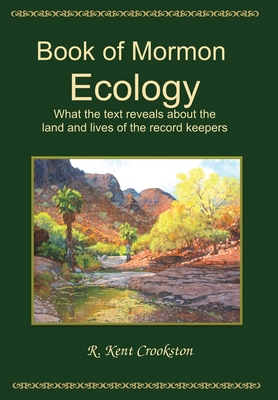
Book of Mormon Ecology: What the Text Reveals About the Land and Lives of the Record Keepers
An Alternative Hypothesis
Book of Mormon record keepers drew upon the natural world thousands of times to enrich their speaking and writing. Their many references to beasts, fruit, seashores, stones, trees, vineyards, and wildernesses provide amazing insights into how and where those record keepers lived.
A near consensus among Latter-day Saint scholars is that Mesoamerica is the land of the Book of Mormon. Drawing on his understanding of crop physiology, Crookston researches an alternate hypothesis--that Lehi's party landed in a Jerusalem-like Mediterranean eco-region of the Americas, and that the record keepers from Nephi to Moroni stayed and lived in such a region.
Crookston evaluates the usage of 107 ecology-related Book of Mormon words including plants, animals and lands in all their spiritual and temporal contexts. He considers subjects such as Nephi's words about how remarkably their Jerusalem-gathered seeds performed in the New World and what implications this carries for Nephi's growing location in the New World. These analyses provide considerable insight into the record keepers' lives and culture, and enable a determination as to whether each word is a better fit with a Mesoamerican or Mediterranean-like region.
The consistency of the text is remarkable. There is nothing random or chaotic about the alignment of its ecology-related wording. In all categories (plants, animals, and land), when there is a better eco-zone fit, that fit is always with the Mediterranean option. Such natural-world stability across almost 3,000 years of history, numerous authors, and 2,065 verses, is striking; in a unique and unexpected way it serves to validate the text. A sampling of words that turn out to be significant eco-territory discriminators are barley, bones, cement, horses, seeds, water, and wolf.
The compelling conclusion of this work is that, based on the ecological information in the text, Mesoamerica should be seriously reassessed as the land where the Book of Mormon record keepers lived. The hypothesis that an American Mediterranean eco-zone served as their home definitely deserves further investigation.
PRP: 245.51 Lei

Acesta este Prețul Recomandat de Producător. Prețul de vânzare al produsului este afișat mai jos.
220.96Lei
220.96Lei
245.51 LeiPrimești 220 puncte
Indisponibil
Descrierea produsului
An Alternative Hypothesis
Book of Mormon record keepers drew upon the natural world thousands of times to enrich their speaking and writing. Their many references to beasts, fruit, seashores, stones, trees, vineyards, and wildernesses provide amazing insights into how and where those record keepers lived.
A near consensus among Latter-day Saint scholars is that Mesoamerica is the land of the Book of Mormon. Drawing on his understanding of crop physiology, Crookston researches an alternate hypothesis--that Lehi's party landed in a Jerusalem-like Mediterranean eco-region of the Americas, and that the record keepers from Nephi to Moroni stayed and lived in such a region.
Crookston evaluates the usage of 107 ecology-related Book of Mormon words including plants, animals and lands in all their spiritual and temporal contexts. He considers subjects such as Nephi's words about how remarkably their Jerusalem-gathered seeds performed in the New World and what implications this carries for Nephi's growing location in the New World. These analyses provide considerable insight into the record keepers' lives and culture, and enable a determination as to whether each word is a better fit with a Mesoamerican or Mediterranean-like region.
The consistency of the text is remarkable. There is nothing random or chaotic about the alignment of its ecology-related wording. In all categories (plants, animals, and land), when there is a better eco-zone fit, that fit is always with the Mediterranean option. Such natural-world stability across almost 3,000 years of history, numerous authors, and 2,065 verses, is striking; in a unique and unexpected way it serves to validate the text. A sampling of words that turn out to be significant eco-territory discriminators are barley, bones, cement, horses, seeds, water, and wolf.
The compelling conclusion of this work is that, based on the ecological information in the text, Mesoamerica should be seriously reassessed as the land where the Book of Mormon record keepers lived. The hypothesis that an American Mediterranean eco-zone served as their home definitely deserves further investigation.
Detaliile produsului



