







Branding Trust: Advertising and Trademarks in Nineteenth-Century America
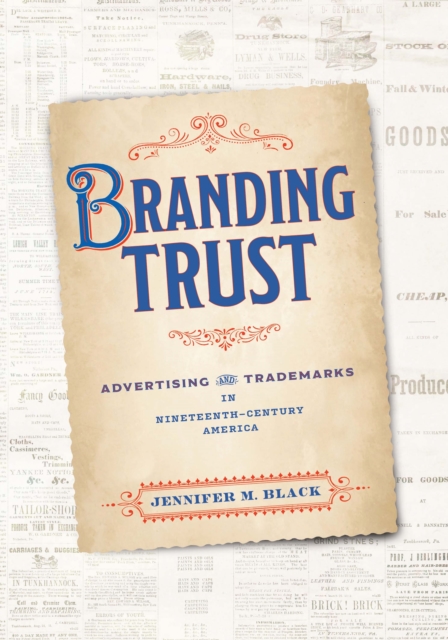
Branding Trust: Advertising and Trademarks in Nineteenth-Century America
In the early nineteenth century, the American commercial marketplace was a chaotic, unregulated environment in which knock-offs and outright frauds thrived. Appearances could be deceiving, and entrepreneurs often relied on their personal reputations to close deals and make sales. Rapid industrialization and expanding trade routes opened new markets with enormous potential, but how could distant merchants convince potential customers, whom they had never met, that they could be trusted? Through wide-ranging visual and textual evidence, including a robust selection of early advertisements, Branding Trust tells the story of how advertising evolved to meet these challenges, tracing the themes of character and class as they intertwined with and influenced graphic design, trademark law, and ideas about ethical business practice in the United States.
As early as the 1830s, printers, advertising agents, and manufacturers collaborated to devise new ways to advertise goods. They used eye-catching designs and fonts to grab viewers' attention and wove together meaningful images and prose to gain the public's trust. At the same time, manufacturers took legal steps to safeguard their intellectual property, formulating new ways to protect their brands by taking legal action against counterfeits and frauds. By the end of the nineteenth century, these advertising and legal strategies came together to form the primary components of modern branding: demonstrating character, protecting goodwill, entertaining viewers to build rapport, and deploying the latest graphic innovations in print. Trademarks became the symbols that embodied these ideas--in print, in the law, and to the public. Branding Trust thus identifies and explains the visual rhetoric of trust and legitimacy that has come to reign over American capitalism. Though the 1920s has often been held up as the birth of modern advertising, Jennifer M. Black argues that advertising professionals had in fact learned how to navigate public relations over the previous century by adapting the language, imagery, and ideas of the American middle class.PRP: 438.73 Lei

Acesta este Prețul Recomandat de Producător. Prețul de vânzare al produsului este afișat mai jos.
394.86Lei
394.86Lei
438.73 LeiPrimești 394 puncte
Indisponibil
Descrierea produsului
In the early nineteenth century, the American commercial marketplace was a chaotic, unregulated environment in which knock-offs and outright frauds thrived. Appearances could be deceiving, and entrepreneurs often relied on their personal reputations to close deals and make sales. Rapid industrialization and expanding trade routes opened new markets with enormous potential, but how could distant merchants convince potential customers, whom they had never met, that they could be trusted? Through wide-ranging visual and textual evidence, including a robust selection of early advertisements, Branding Trust tells the story of how advertising evolved to meet these challenges, tracing the themes of character and class as they intertwined with and influenced graphic design, trademark law, and ideas about ethical business practice in the United States.
As early as the 1830s, printers, advertising agents, and manufacturers collaborated to devise new ways to advertise goods. They used eye-catching designs and fonts to grab viewers' attention and wove together meaningful images and prose to gain the public's trust. At the same time, manufacturers took legal steps to safeguard their intellectual property, formulating new ways to protect their brands by taking legal action against counterfeits and frauds. By the end of the nineteenth century, these advertising and legal strategies came together to form the primary components of modern branding: demonstrating character, protecting goodwill, entertaining viewers to build rapport, and deploying the latest graphic innovations in print. Trademarks became the symbols that embodied these ideas--in print, in the law, and to the public. Branding Trust thus identifies and explains the visual rhetoric of trust and legitimacy that has come to reign over American capitalism. Though the 1920s has often been held up as the birth of modern advertising, Jennifer M. Black argues that advertising professionals had in fact learned how to navigate public relations over the previous century by adapting the language, imagery, and ideas of the American middle class.Detaliile produsului



