







Democratic Anarchy: Aesthetics and Political Resistance in U.S. Literature
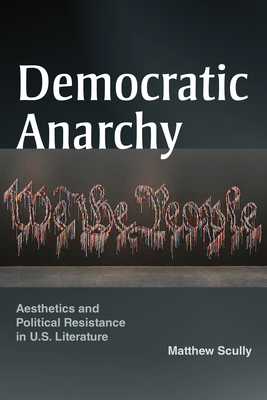
Democratic Anarchy: Aesthetics and Political Resistance in U.S. Literature
A dramatic and necessary rethinking of the meaning of Democracy
Democratic Anarchy grapples with an uncomfortable but obvious truth inimical to democracy: both aesthetics and politics depend on the structuring antagonism of inclusion and exclusion. Yet in Democratic Anarchy, Matthew Scully asks, how can "the people" be represented in a way that acknowledges what remains unrepresentable? What would it mean to face up to the constitutive exclusions that haunt U.S. democracy and its anxious fantasies of equality? Synthesizing a broad range of theoretical traditions and interlocutors--including Lacan, Rancière, Edelman, and Hartman--Democratic Anarchy polemically declares that there has never been, nor can there ever be, a realized democracy in the U.S. because democracy always depends on the hierarchical institution of a formal order by one part of the population over another. Engaging with an expansive corpus of American literature and art (Harriet Jacobs, Nathaniel Hawthorne, Louis Zukofsky, Thomas Pynchon, Toni Morrison, Theresa Hak Kyung Cha, Nari Ward, Ocean Vuong, and Safiya Sinclair), Democratic Anarchy argues that many liberal concepts and institutions are in fact structurally opposed to democratic equality because they depend on regulating what can appear and in what form. By focusing on works that disrupt this regulatory impulse, Scully shows how rhetorical strate-gies of interruption, excess, and disorder figure the anarchic equality that inegalitarian fantasies of democracy disavow. Democratic Anarchy develops a rigorous theory of equality that refuses to repeat the inequalities against which it positions itself, and it does so by turning to moments of resistance--both aesthetic and political--inaugurated by the equality that inheres in and antago-nizes the order of things.PRP: 343.58 Lei

Acesta este Prețul Recomandat de Producător. Prețul de vânzare al produsului este afișat mai jos.
309.22Lei
309.22Lei
343.58 LeiPrimești 309 puncte
Indisponibil
Descrierea produsului
A dramatic and necessary rethinking of the meaning of Democracy
Democratic Anarchy grapples with an uncomfortable but obvious truth inimical to democracy: both aesthetics and politics depend on the structuring antagonism of inclusion and exclusion. Yet in Democratic Anarchy, Matthew Scully asks, how can "the people" be represented in a way that acknowledges what remains unrepresentable? What would it mean to face up to the constitutive exclusions that haunt U.S. democracy and its anxious fantasies of equality? Synthesizing a broad range of theoretical traditions and interlocutors--including Lacan, Rancière, Edelman, and Hartman--Democratic Anarchy polemically declares that there has never been, nor can there ever be, a realized democracy in the U.S. because democracy always depends on the hierarchical institution of a formal order by one part of the population over another. Engaging with an expansive corpus of American literature and art (Harriet Jacobs, Nathaniel Hawthorne, Louis Zukofsky, Thomas Pynchon, Toni Morrison, Theresa Hak Kyung Cha, Nari Ward, Ocean Vuong, and Safiya Sinclair), Democratic Anarchy argues that many liberal concepts and institutions are in fact structurally opposed to democratic equality because they depend on regulating what can appear and in what form. By focusing on works that disrupt this regulatory impulse, Scully shows how rhetorical strate-gies of interruption, excess, and disorder figure the anarchic equality that inegalitarian fantasies of democracy disavow. Democratic Anarchy develops a rigorous theory of equality that refuses to repeat the inequalities against which it positions itself, and it does so by turning to moments of resistance--both aesthetic and political--inaugurated by the equality that inheres in and antago-nizes the order of things.Detaliile produsului



