





Ending the French Revolution: Violence, Justice, and Repression from the Terror to Napoleon
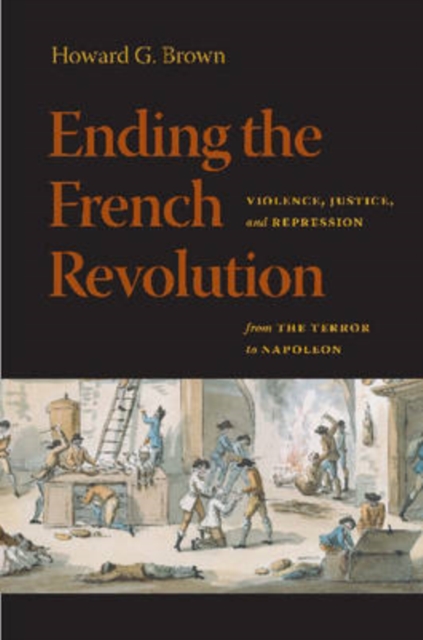
Ending the French Revolution: Violence, Justice, and Repression from the Terror to Napoleon
"Filled with critical insights, Brown's revisionist study utilizes an impressive array of archival sources, some only recently cataloged, to support his thesis that the French Revolution survived until 1802 and the Consulate regime.... This volume should be a priority for all historians and serious students interested in modern French history. Summing Up: Essential."--Choice
"What Brown has done is to put all historians of the French Revolution in his debt by the thoroughness with which he explores an important aspect of the complex and interrelated problems posed by any attempt to create a new social and moral order based on principles that could prove to be self-contradictory and were neither understood nor welcomed by a substantial proportion of the population."--English Historical Review
"This is one of the most important pieces of scholarship on the French Revolution since the 1989 bicentennial."--David Bell, Johns Hopkins University
For two centuries, the early years of the French Revolution have inspired countless democratic movements around the world. Yet little attention has been paid to the problems of violence, justice, and repression between the Reign of Terror and the dictatorship of Napoleon Bonaparte. In Ending the French Revolution, Howard Brown analyzes these years to reveal the true difficulty of founding a liberal democracy in the midst of continual warfare, repeated coups d'état, and endemic civil strife. By highlighting the role played by violence and fear in generating illiberal politics, Brown speaks to the struggles facing democracy in our own age. The result is a fundamentally new understanding of the French Revolution's disappointing outcome.
Howard G. Brown, Professor of History at Binghamton University, State University of New York, is the author of War, Revolution, and the Bureaucratic State: Politics and Army Administration in France, 1791-1799 and coeditor of Taking Liberties: Problems of a New Order from the French Revolution to Napoleon.
Winner of the American Historical Association's 2006 Leo Gershoy Award and the University of Virginia's 2004 Walker Cowen Memorial Prize for an outstanding work of scholarship in eighteenth-century studies
PRP: 170.50 Lei

Acesta este Prețul Recomandat de Producător. Prețul de vânzare al produsului este afișat mai jos.
136.40Lei
136.40Lei
170.50 LeiPrimești 136 puncte
Livrare in 2-4 saptamani
Descrierea produsului
"Filled with critical insights, Brown's revisionist study utilizes an impressive array of archival sources, some only recently cataloged, to support his thesis that the French Revolution survived until 1802 and the Consulate regime.... This volume should be a priority for all historians and serious students interested in modern French history. Summing Up: Essential."--Choice
"What Brown has done is to put all historians of the French Revolution in his debt by the thoroughness with which he explores an important aspect of the complex and interrelated problems posed by any attempt to create a new social and moral order based on principles that could prove to be self-contradictory and were neither understood nor welcomed by a substantial proportion of the population."--English Historical Review
"This is one of the most important pieces of scholarship on the French Revolution since the 1989 bicentennial."--David Bell, Johns Hopkins University
For two centuries, the early years of the French Revolution have inspired countless democratic movements around the world. Yet little attention has been paid to the problems of violence, justice, and repression between the Reign of Terror and the dictatorship of Napoleon Bonaparte. In Ending the French Revolution, Howard Brown analyzes these years to reveal the true difficulty of founding a liberal democracy in the midst of continual warfare, repeated coups d'état, and endemic civil strife. By highlighting the role played by violence and fear in generating illiberal politics, Brown speaks to the struggles facing democracy in our own age. The result is a fundamentally new understanding of the French Revolution's disappointing outcome.
Howard G. Brown, Professor of History at Binghamton University, State University of New York, is the author of War, Revolution, and the Bureaucratic State: Politics and Army Administration in France, 1791-1799 and coeditor of Taking Liberties: Problems of a New Order from the French Revolution to Napoleon.
Winner of the American Historical Association's 2006 Leo Gershoy Award and the University of Virginia's 2004 Walker Cowen Memorial Prize for an outstanding work of scholarship in eighteenth-century studies
Detaliile produsului



