





Fag Hag
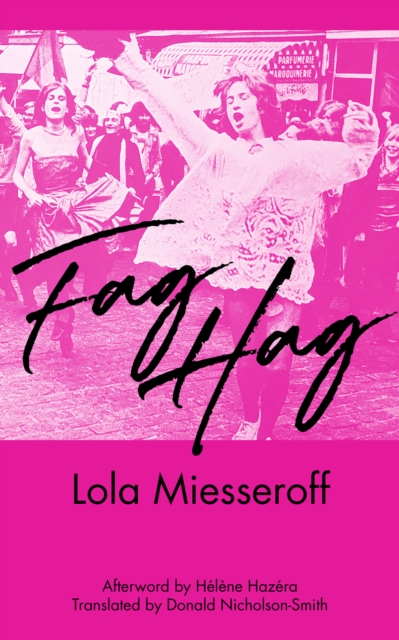
Fag Hag
"Some girls fancy sailors, others fancy soldiers. But you, my dear, are a fag hag!"
Lola Miesseroff's childhood certainly predisposed her to be a rebel. She was born in Marseilles in 1947 to immigrant parents, her mother a Russian-Jewish social worker, her father an Armenian-Russian with a sandpaper-making workshop in sheds left behind by the Americans. The family ran and lived in a nudist colony, a place where the men were allowed to be feminine, the women masculine. Hers was what she calls a "degendered" childhood: "I never suffered from identity problems. There were two genocides in my background, one Jewish, the other Armenian, and my education was Russophone, naturist and libertarian, not least with respect to love and sex. In other words, we were marginal in every possible way."
Lola's picaresque memoir Fag Hag tracks her peregrinations through what she calls the "Outer Left"--always deeply committed and involved in women's liberation, sexual liberation, gay, and LBGTQ liberation--yet always on the fringe of formal organizations (or driven there) because of her belief that anarcho-communist revolution (not her term) trumps all (inter)sectional struggles without reducing them. From Marseilles to Avignon and Paris, Lola's trajectory epitomizes a far left that opposed a spirit of provocation and raillery to the austerity of many militant groupuscules and experimented enthusiastically with communal and polysexual living.
"I have dredged my memory," Lola writes, "in the hope that revisiting the past might help illuminate our present; if it doesn't, I shall have failed. I want to contribute in some small measure to the struggles of today by exposing the strengths and weaknesses of the struggles of the past, and to contest fragmented identity politics in favor of all-for-one-and-one-for-all. Which is my way of continuing to challenge the power structure."
PRP: 122.33 Lei

Acesta este Prețul Recomandat de Producător. Prețul de vânzare al produsului este afișat mai jos.
110.10Lei
110.10Lei
122.33 LeiPrimești 110 puncte
Livrare in 2-4 saptamani
Descrierea produsului
"Some girls fancy sailors, others fancy soldiers. But you, my dear, are a fag hag!"
Lola Miesseroff's childhood certainly predisposed her to be a rebel. She was born in Marseilles in 1947 to immigrant parents, her mother a Russian-Jewish social worker, her father an Armenian-Russian with a sandpaper-making workshop in sheds left behind by the Americans. The family ran and lived in a nudist colony, a place where the men were allowed to be feminine, the women masculine. Hers was what she calls a "degendered" childhood: "I never suffered from identity problems. There were two genocides in my background, one Jewish, the other Armenian, and my education was Russophone, naturist and libertarian, not least with respect to love and sex. In other words, we were marginal in every possible way."
Lola's picaresque memoir Fag Hag tracks her peregrinations through what she calls the "Outer Left"--always deeply committed and involved in women's liberation, sexual liberation, gay, and LBGTQ liberation--yet always on the fringe of formal organizations (or driven there) because of her belief that anarcho-communist revolution (not her term) trumps all (inter)sectional struggles without reducing them. From Marseilles to Avignon and Paris, Lola's trajectory epitomizes a far left that opposed a spirit of provocation and raillery to the austerity of many militant groupuscules and experimented enthusiastically with communal and polysexual living.
"I have dredged my memory," Lola writes, "in the hope that revisiting the past might help illuminate our present; if it doesn't, I shall have failed. I want to contribute in some small measure to the struggles of today by exposing the strengths and weaknesses of the struggles of the past, and to contest fragmented identity politics in favor of all-for-one-and-one-for-all. Which is my way of continuing to challenge the power structure."
Detaliile produsului



