





Great Cases in Constitutional Law
Great Cases in Constitutional Law
Slavery, segregation, abortion, workers' rights, the power of the courts. These issues have been at the heart of the greatest constitutional controversies in American history. And in this concise and thought-provoking volume, some of today's most distinguished legal scholars and commentators explain for a general audience how five landmark Supreme Court cases centered on those controversies shaped the country's destiny and continue to affect us even now. The book is a profound exploration of the Supreme Court's importance to America's social and political life. It is also, as many of the contributors show, an intriguing reflection of what some have seen as an important trend in legal scholarship away from an uncritical belief in the essentially benign nature of judicial power.
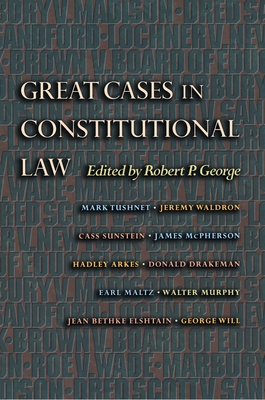
Robert George opens with an illuminating survey of the themes that unite and divide the five cases. Other contributors then examine each case in detail through a lively commentary-and-response format. Mark Tushnet and Jeremy Waldron exchange views on Marbury v. Madison, the pivotal 1803 case that established the power of the courts to invalidate legislation. Cass Sunstein and James McPherson discuss Dred Scott v. Sandford (1857), the notorious case that confirmed the rights of slaveowners, declared that black people could not be American citizens, and is often seen as a cause of the Civil War. Hadley Arkes and Donald Drakeman explore the legacy of Lochner v. New York (1905), a case that ushered in decades of judicial hostility to social welfare laws. Earl Maltz and Walter Murphy assess Brown v. Topeka Board of Education (1954), the famous case that ended racial segregation in public schools. Finally, Jean Bethke Elshtain and George Will tackle Roe v. Wade (1973), still a flashpoint a quarter of a century later in the debate over abortion. While some of the contributors show sympathy for strong judicial interventions on social issues, many across the ideological spectrum are sharply critical of judicial activism. A compelling introduction to the greatest cases in U.S. constitutional law, this is also an enlightening glimpse of the state of the art in American legal scholarship.PRP: 461.38 Lei

Acesta este Prețul Recomandat de Producător. Prețul de vânzare al produsului este afișat mai jos.
415.24Lei
415.24Lei
461.38 LeiPrimești 415 puncte
Livrare in 2-4 saptamani
Descrierea produsului
Slavery, segregation, abortion, workers' rights, the power of the courts. These issues have been at the heart of the greatest constitutional controversies in American history. And in this concise and thought-provoking volume, some of today's most distinguished legal scholars and commentators explain for a general audience how five landmark Supreme Court cases centered on those controversies shaped the country's destiny and continue to affect us even now. The book is a profound exploration of the Supreme Court's importance to America's social and political life. It is also, as many of the contributors show, an intriguing reflection of what some have seen as an important trend in legal scholarship away from an uncritical belief in the essentially benign nature of judicial power.
Robert George opens with an illuminating survey of the themes that unite and divide the five cases. Other contributors then examine each case in detail through a lively commentary-and-response format. Mark Tushnet and Jeremy Waldron exchange views on Marbury v. Madison, the pivotal 1803 case that established the power of the courts to invalidate legislation. Cass Sunstein and James McPherson discuss Dred Scott v. Sandford (1857), the notorious case that confirmed the rights of slaveowners, declared that black people could not be American citizens, and is often seen as a cause of the Civil War. Hadley Arkes and Donald Drakeman explore the legacy of Lochner v. New York (1905), a case that ushered in decades of judicial hostility to social welfare laws. Earl Maltz and Walter Murphy assess Brown v. Topeka Board of Education (1954), the famous case that ended racial segregation in public schools. Finally, Jean Bethke Elshtain and George Will tackle Roe v. Wade (1973), still a flashpoint a quarter of a century later in the debate over abortion. While some of the contributors show sympathy for strong judicial interventions on social issues, many across the ideological spectrum are sharply critical of judicial activism. A compelling introduction to the greatest cases in U.S. constitutional law, this is also an enlightening glimpse of the state of the art in American legal scholarship.Detaliile produsului



