





Johnny's Decisions: Economics for Kids: Tradeoffs
Johnny's Decisions: Economics for Kids: Tradeoffs
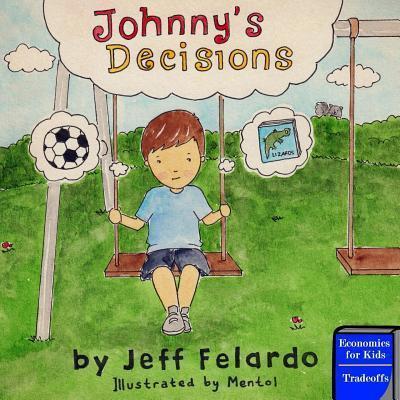
Economics is about more than money. Kids can learn about economics through stories without being exposed to the hard terminology. "Economics for kids? Really? Yeah....." Some people don't realize that economics is about more than money. In fact, I am an environmental economist and rarely study money. Economics is about decision making and being fully informed of the outcomes or consequences of your decisions. I think that most economics principles can be told in an engaging way through the use of stories. Why kids? Adults (even most college students) seem to hate economics. Maybe because they think it's hard, evil, or because they don't like to think about money. Kids don't have this bias. They want to learn about everything especially if it is entertaining. That is why this book was written to be entertaining and beautiful first, educational second. Also, exposure to economics (without the terminology) introduces children to critical thinking, cause and effect, and encourages questioning. These concepts have been targeted as skills our children need to be successful in both school and life. What is this book about? The book combines an interesting story about normal life and ideas related to economics. The goal is to write an interesting story first, and then apply stress to certain scenarios that can act as learning opportunities. For example, instead of just deciding to buy a soccer ball; character's would imagine what the outcomes would be based on this decision. The characters also have short dialogues with friends, parents, and themselves to flesh their decision making process. This expansion of the thought process highlights the idea of a tradeoff (or scarcity) which can be stressed by a parent or teacher.
PRP: 77.42 Lei

Acesta este Prețul Recomandat de Producător. Prețul de vânzare al produsului este afișat mai jos.
61.94Lei
61.94Lei
77.42 LeiPrimești 61 puncte
Indisponibil
Descrierea produsului
Economics is about more than money. Kids can learn about economics through stories without being exposed to the hard terminology. "Economics for kids? Really? Yeah....." Some people don't realize that economics is about more than money. In fact, I am an environmental economist and rarely study money. Economics is about decision making and being fully informed of the outcomes or consequences of your decisions. I think that most economics principles can be told in an engaging way through the use of stories. Why kids? Adults (even most college students) seem to hate economics. Maybe because they think it's hard, evil, or because they don't like to think about money. Kids don't have this bias. They want to learn about everything especially if it is entertaining. That is why this book was written to be entertaining and beautiful first, educational second. Also, exposure to economics (without the terminology) introduces children to critical thinking, cause and effect, and encourages questioning. These concepts have been targeted as skills our children need to be successful in both school and life. What is this book about? The book combines an interesting story about normal life and ideas related to economics. The goal is to write an interesting story first, and then apply stress to certain scenarios that can act as learning opportunities. For example, instead of just deciding to buy a soccer ball; character's would imagine what the outcomes would be based on this decision. The characters also have short dialogues with friends, parents, and themselves to flesh their decision making process. This expansion of the thought process highlights the idea of a tradeoff (or scarcity) which can be stressed by a parent or teacher.
Detaliile produsului



