





Meraki: Love Letters to Language
Meraki: Love Letters to Language
English stinks. I love to write in English mostly because it stinks. Bullying English by exploiting its grammar, homonyms, and numerous other peculiarities can make for amusing poetry. However, I find the language to have one unforgivable flaw: there is only one word for the notion of love. While Sanskrit boasts 96 words for love, we use one measly, catch-all term to describe feelings towards coffee, family, partners, and strangers alike.
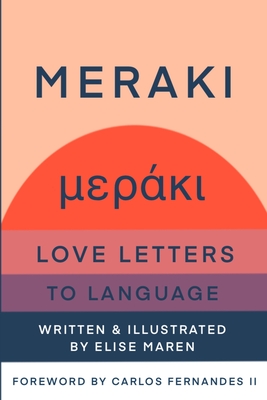
When I was trying to come up with a way to categorize poems written from age fifteen to the present, the only thing I could come up with was to organize themes in terms of what type of love they convey. The Greek language facilitated this, and a book with Greek chapters needs a Greek title. From there, Meraki: Love Letters to Language was born. The title came quite naturally, as I have poured much of myself into this work. The subject sections include self-love, fondness, flirtation, desire, enduring love, familial love, love for humanity, lament, and hospitality. The themes vary widely: nature, queerness, spirituality, community, grief, and more.
As you'll see throughout Meraki, I find language generally fascinating. However, don't mistake me for a polyglot. It's all Greek to me - pun intended. You'll find poems that draw inspiration from Greek, Hebrew, Hmong, Somali, Spanish, Norwegian, Japanese, French, and Northern Sámi. Many thanks to the native speakers who helped me verify translations and concepts. Some poems are fully in another language and then translated into English on the next page. One poem in this book is only in English but is nearly unrecognizable; it uses obsolete vocabulary to tell a story about someone who reads the dictionary as she falls hopelessly in love with a librarian. Don't worry, I provided a glossary on the next page.
At the end of the book, you'll find an appendix providing further information and context about each poem if you'd like to learn more or did not catch a reference. I'm always curious what writers were thinking while they wrote, so I provided a bit of the behind the scenes for you. I aim to write the kinds of books I'd want to read.
Meraki is simultaneously a love letter to language and hate mail addressed specifically to English's rusty, old mailbox. I hope you enjoy reading Meraki just as much as I enjoyed creating it.
PRP: 105.40 Lei

Acesta este Prețul Recomandat de Producător. Prețul de vânzare al produsului este afișat mai jos.
94.86Lei
94.86Lei
105.40 LeiPrimești 94 puncte
Livrare in 2-4 saptamani
Descrierea produsului
English stinks. I love to write in English mostly because it stinks. Bullying English by exploiting its grammar, homonyms, and numerous other peculiarities can make for amusing poetry. However, I find the language to have one unforgivable flaw: there is only one word for the notion of love. While Sanskrit boasts 96 words for love, we use one measly, catch-all term to describe feelings towards coffee, family, partners, and strangers alike.
When I was trying to come up with a way to categorize poems written from age fifteen to the present, the only thing I could come up with was to organize themes in terms of what type of love they convey. The Greek language facilitated this, and a book with Greek chapters needs a Greek title. From there, Meraki: Love Letters to Language was born. The title came quite naturally, as I have poured much of myself into this work. The subject sections include self-love, fondness, flirtation, desire, enduring love, familial love, love for humanity, lament, and hospitality. The themes vary widely: nature, queerness, spirituality, community, grief, and more.
As you'll see throughout Meraki, I find language generally fascinating. However, don't mistake me for a polyglot. It's all Greek to me - pun intended. You'll find poems that draw inspiration from Greek, Hebrew, Hmong, Somali, Spanish, Norwegian, Japanese, French, and Northern Sámi. Many thanks to the native speakers who helped me verify translations and concepts. Some poems are fully in another language and then translated into English on the next page. One poem in this book is only in English but is nearly unrecognizable; it uses obsolete vocabulary to tell a story about someone who reads the dictionary as she falls hopelessly in love with a librarian. Don't worry, I provided a glossary on the next page.
At the end of the book, you'll find an appendix providing further information and context about each poem if you'd like to learn more or did not catch a reference. I'm always curious what writers were thinking while they wrote, so I provided a bit of the behind the scenes for you. I aim to write the kinds of books I'd want to read.
Meraki is simultaneously a love letter to language and hate mail addressed specifically to English's rusty, old mailbox. I hope you enjoy reading Meraki just as much as I enjoyed creating it.
Detaliile produsului



