





Nadabindu and Dhyanabindu Upanishads: Meditations on the Inner Sound
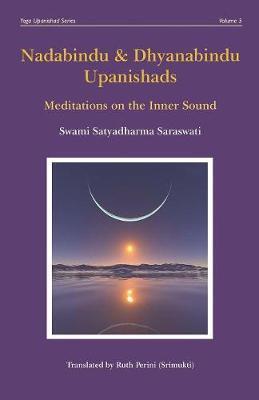
Nadabindu and Dhyanabindu Upanishads: Meditations on the Inner Sound
Included is a foreword on the life and teachings of Swami Satyadharma, who passed away while writing the commentary on Dhyānabindu. Her commentary on Nādabindu is complete. The Dhyāna and Nādabindu Upaniṣads were probably composed between the ninth and fourteenth centuries CE. The bindu is a psychic centre located in the brain at the top back of the head. These upaniṣads focus on meditation on the bindu, the source point or origin of individual creation, where begins the primal sound or first vibration, the mantra Om. They define and describe in detail the mantra Om, the effects of meditating on it until one attains perfect liberation, merging with the Divine.Nādabindu describes the components of Om, that is, its three and a half measures (mātrā) which are the sounds a u m, and the half measure, the echo of m. Always meditating on Om, the yogin is liberated from worldly life, unaffected by his/her karmas. The nāda is first heard through the right ear, and many other inner sounds are heard. Eventually the yogin hears no other sounds and transcends duality.Dhyānabindu, an expansion of Nādabindu, confirms that meditation on Om can destroy all karmas. The yogin should meditate on the lotus of the heart, then at the eyebrow centre, then on the Sun, Moon and Agni, leading to the ātman. The six parts of yoga, the cakras, nāḍīs and prāṇas are described. Kuṇḍalinī Śakti can be awakened by the repetition of the mantra haṃsa, ham spontaneously accompanying the inhalation, and sa the exhalation, as well as uḍḍiyāna and jālandhara bandhas, khecarī mudrā and mahāmudrā. The ātman is described in detail. Finally, the teacher recommends meditating on the bija mantras of the five elements, the five prāṇas and the nāda.
PRP: 118.19 Lei

Acesta este Prețul Recomandat de Producător. Prețul de vânzare al produsului este afișat mai jos.
94.55Lei
94.55Lei
118.19 LeiPrimești 94 puncte
Livrare in 2-4 saptamani
Descrierea produsului
Included is a foreword on the life and teachings of Swami Satyadharma, who passed away while writing the commentary on Dhyānabindu. Her commentary on Nādabindu is complete. The Dhyāna and Nādabindu Upaniṣads were probably composed between the ninth and fourteenth centuries CE. The bindu is a psychic centre located in the brain at the top back of the head. These upaniṣads focus on meditation on the bindu, the source point or origin of individual creation, where begins the primal sound or first vibration, the mantra Om. They define and describe in detail the mantra Om, the effects of meditating on it until one attains perfect liberation, merging with the Divine.Nādabindu describes the components of Om, that is, its three and a half measures (mātrā) which are the sounds a u m, and the half measure, the echo of m. Always meditating on Om, the yogin is liberated from worldly life, unaffected by his/her karmas. The nāda is first heard through the right ear, and many other inner sounds are heard. Eventually the yogin hears no other sounds and transcends duality.Dhyānabindu, an expansion of Nādabindu, confirms that meditation on Om can destroy all karmas. The yogin should meditate on the lotus of the heart, then at the eyebrow centre, then on the Sun, Moon and Agni, leading to the ātman. The six parts of yoga, the cakras, nāḍīs and prāṇas are described. Kuṇḍalinī Śakti can be awakened by the repetition of the mantra haṃsa, ham spontaneously accompanying the inhalation, and sa the exhalation, as well as uḍḍiyāna and jālandhara bandhas, khecarī mudrā and mahāmudrā. The ātman is described in detail. Finally, the teacher recommends meditating on the bija mantras of the five elements, the five prāṇas and the nāda.
Detaliile produsului



