







Principles of Cerebral Mechanics
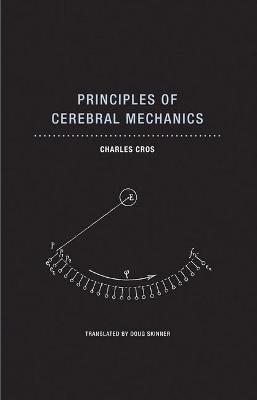
Principles of Cerebral Mechanics
A visionary treatise on perception from the extraordinary polymath Charles Cros--poet, friend to Rimbaud and Verlaine, and inventor of color photography and the phonograph
Establishing the author's standing as the inventeur maudit of his time, Principles of Cerebral Mechanics was first presented to the Academy of Sciences in 1872, but was not published until 1879, and then only in fragmentary form. Setting out to understand the mechanics of perception--the organs of which at the time were too small and inaccessible to be studied directly--Cros instead attempted to reverse-engineer the sensory organs. Whereas his previous inventions in the realms of audio recording and color photography had focused on technology for the senses, with this ambitious essay Cros turned to conceptualizing the technology of the senses themselves: rather than the transmission of color to the retina, here he instead attempted to conceive of how color was transmitted from the retina to the brain. By approaching the human brain as a "mechanism of registration," Cros' essay can be set alongside the groundbreaking work of such revolutionary figures who transformed modern vision as Étienne-Jules Marey and Eadweard Muybridge.
Charles Cros (1842-88) was as much Renaissance man as he was poète maudit. A bohemian poet who drank with Verlaine and provided housing to Rimbaud, he also developed the comic monologue as a theatrical genre, and invented both the phonograph (which he named the "paléophone") and color photography (though he failed to patent either before Thomas Edison or Louis Ducos du Hauron), among other such inventions as a nonmetallic battery and a musical stenographer.
PRP: 81.03 Lei

Acesta este Prețul Recomandat de Producător. Prețul de vânzare al produsului este afișat mai jos.
72.93Lei
72.93Lei
81.03 LeiPrimești 72 puncte
Indisponibil
Descrierea produsului
A visionary treatise on perception from the extraordinary polymath Charles Cros--poet, friend to Rimbaud and Verlaine, and inventor of color photography and the phonograph
Establishing the author's standing as the inventeur maudit of his time, Principles of Cerebral Mechanics was first presented to the Academy of Sciences in 1872, but was not published until 1879, and then only in fragmentary form. Setting out to understand the mechanics of perception--the organs of which at the time were too small and inaccessible to be studied directly--Cros instead attempted to reverse-engineer the sensory organs. Whereas his previous inventions in the realms of audio recording and color photography had focused on technology for the senses, with this ambitious essay Cros turned to conceptualizing the technology of the senses themselves: rather than the transmission of color to the retina, here he instead attempted to conceive of how color was transmitted from the retina to the brain. By approaching the human brain as a "mechanism of registration," Cros' essay can be set alongside the groundbreaking work of such revolutionary figures who transformed modern vision as Étienne-Jules Marey and Eadweard Muybridge.
Charles Cros (1842-88) was as much Renaissance man as he was poète maudit. A bohemian poet who drank with Verlaine and provided housing to Rimbaud, he also developed the comic monologue as a theatrical genre, and invented both the phonograph (which he named the "paléophone") and color photography (though he failed to patent either before Thomas Edison or Louis Ducos du Hauron), among other such inventions as a nonmetallic battery and a musical stenographer.
Detaliile produsului



