







Rhodesian Fire Force 1966-80
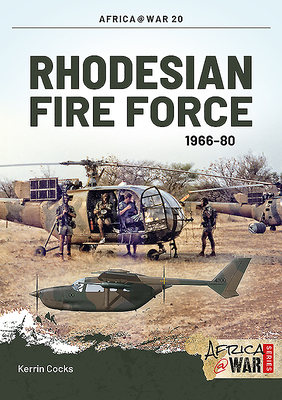
Rhodesian Fire Force 1966-80
On 11 November 1965, Rhodesian prime minister Ian Smith unilaterally declared his country independent of Britain. International sanctions were immediately instituted against the minority white regime as Robert Mugabe's ZANLA and Joshua Nkomo's ZIPRA armies commenced their armed struggle, the Chimurenga, the war of liberation. As Communist-trained guerrillas flooded the country, the beleaguered Rhodesians, hard-pressed for manpower and military resources, were forced to devise new and innovative methods to combat the insurgency. Fire Force was their answer. Fire Force as a military concept dates from 1974 when the Rhodesian Air Force (RhAF) acquired the French MG151 20mm cannon from the Portuguese. Visionary RhAF and Rhodesian Light Infantry (RLI) officers expanded on the idea of a 'vertical envelopment' of the enemy, with the 20mm cannon being the principal weapon of attack, mounted in an Alouette III K-Car ('Killer car'), supported by ground troops deployed from G-Cars (Alouette III troop-carrying gunships and latterly Bell 'Hueys') and parachuted from DC-3 Dakotas. In support would be a propeller-driven ground-attack aircraft armed with front guns, pods of napalm, white phosphorus rockets and a variety of Rhodesian-designed bombs; on call would be Canberra bombers, Hawker Hunter and Vampire jets. In spite of the overwhelming number of enemy pitted against them, Rhodesian Fire Forces accounted for thousands of enemy guerrillas, with a kill ratio exceeding 80:1. At the end of the war, ZANLA generals admitted their army could not have survived another year in the field-in no small part due to the ruthless efficiency of the Fire Forces, described by Charles D. Melson, the Chief Historian of the U.S. Marine Corps, as the ultimate "killing machine".
PRP: 143.64 Lei

Acesta este Prețul Recomandat de Producător. Prețul de vânzare al produsului este afișat mai jos.
129.28Lei
129.28Lei
143.64 LeiPrimești 129 puncte
Indisponibil
Descrierea produsului
On 11 November 1965, Rhodesian prime minister Ian Smith unilaterally declared his country independent of Britain. International sanctions were immediately instituted against the minority white regime as Robert Mugabe's ZANLA and Joshua Nkomo's ZIPRA armies commenced their armed struggle, the Chimurenga, the war of liberation. As Communist-trained guerrillas flooded the country, the beleaguered Rhodesians, hard-pressed for manpower and military resources, were forced to devise new and innovative methods to combat the insurgency. Fire Force was their answer. Fire Force as a military concept dates from 1974 when the Rhodesian Air Force (RhAF) acquired the French MG151 20mm cannon from the Portuguese. Visionary RhAF and Rhodesian Light Infantry (RLI) officers expanded on the idea of a 'vertical envelopment' of the enemy, with the 20mm cannon being the principal weapon of attack, mounted in an Alouette III K-Car ('Killer car'), supported by ground troops deployed from G-Cars (Alouette III troop-carrying gunships and latterly Bell 'Hueys') and parachuted from DC-3 Dakotas. In support would be a propeller-driven ground-attack aircraft armed with front guns, pods of napalm, white phosphorus rockets and a variety of Rhodesian-designed bombs; on call would be Canberra bombers, Hawker Hunter and Vampire jets. In spite of the overwhelming number of enemy pitted against them, Rhodesian Fire Forces accounted for thousands of enemy guerrillas, with a kill ratio exceeding 80:1. At the end of the war, ZANLA generals admitted their army could not have survived another year in the field-in no small part due to the ruthless efficiency of the Fire Forces, described by Charles D. Melson, the Chief Historian of the U.S. Marine Corps, as the ultimate "killing machine".
Detaliile produsului



