





Spiritual Injuries, Traumatic Assaults on the Soul: My Journey Through Childhood and Family Trauma to Recovery
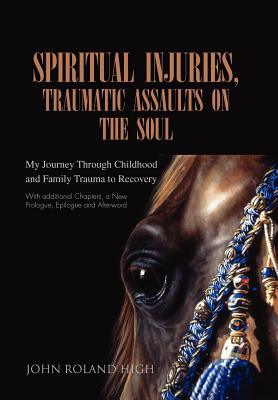
Spiritual Injuries, Traumatic Assaults on the Soul: My Journey Through Childhood and Family Trauma to Recovery
This is not a book about Religion, as so many of my readers have inquired to me about. It is about my journey through the childhood and adolescent psychological injuries to my spiritual self. *(c)Spiritual Injuries are the often conscious and willful attempts to deliberately degrade and diminish the development of the psyche of the child/ person and thereby alter and or re-direct the ongoing moral developmental stages of the moral, psychological and physiological structure of the mental, social and behavioral presentations of the individual (s), group, race, culture and their very livelihood. Spiritual injuries are an attempt (s) to change and render ones complete character, sense of well-being and dependence to something or someone outside of themselves, in a dominating effort to subjugate and take over control of the person. Being analogous to Battered Women's Syndrome (BWS) Battered Men's Syndrome and Battered Children's Syndrome (see Appendix M) and Posttraumatic Stress Disorder (PTSD) (see Appendix H), Spiritual Injuries describes someone who currently is or has been the victim of ongoing, consistent repeatedly severe violence to the point where this violence results in Psychological Trauma, the overwhelming demands placed upon the psychological system that results in a profound felt sense of vulnerability and/ or loss of control (van der Kolk and McFarlane, 1996.) This is to include myriad forms of violence as in domestic violent intrusions, as mentioned earlier, and/ or consistent and repeated attempts at diminishing and degrading ones ego and self-esteem and survival systems.(see Appendix O, Psychological Trauma, The Human Stress Continuum). Children are born vulnerable to the behaviors of their parents, caretakers and remain vulnerable throughout their latency stage, preadolescent, adolescent to their young adulthood. Often, adverse early childhood experiences have a far-reaching impact on the children's developmental stages. Because of its sometimes subtle applications, Spiritual Injuries are often denied by the victim (s) who often expresses guilt and makes excuses for the abuser/ victimizer, relying on their hope, optimism and on their resiliency to recover from the abuse, and because of developmental circumstances, remain with their abuser. In an attempt to escape their abuse, children often run away from home (a clear notice that "something is wrong in Denmark.") Unfortunately, even Social Services often miss or ignore these signs of abuse, o
PRP: 289.25 Lei

Acesta este Prețul Recomandat de Producător. Prețul de vânzare al produsului este afișat mai jos.
260.32Lei
260.32Lei
289.25 LeiPrimești 260 puncte
Livrare in 2-4 saptamani
Descrierea produsului
This is not a book about Religion, as so many of my readers have inquired to me about. It is about my journey through the childhood and adolescent psychological injuries to my spiritual self. *(c)Spiritual Injuries are the often conscious and willful attempts to deliberately degrade and diminish the development of the psyche of the child/ person and thereby alter and or re-direct the ongoing moral developmental stages of the moral, psychological and physiological structure of the mental, social and behavioral presentations of the individual (s), group, race, culture and their very livelihood. Spiritual injuries are an attempt (s) to change and render ones complete character, sense of well-being and dependence to something or someone outside of themselves, in a dominating effort to subjugate and take over control of the person. Being analogous to Battered Women's Syndrome (BWS) Battered Men's Syndrome and Battered Children's Syndrome (see Appendix M) and Posttraumatic Stress Disorder (PTSD) (see Appendix H), Spiritual Injuries describes someone who currently is or has been the victim of ongoing, consistent repeatedly severe violence to the point where this violence results in Psychological Trauma, the overwhelming demands placed upon the psychological system that results in a profound felt sense of vulnerability and/ or loss of control (van der Kolk and McFarlane, 1996.) This is to include myriad forms of violence as in domestic violent intrusions, as mentioned earlier, and/ or consistent and repeated attempts at diminishing and degrading ones ego and self-esteem and survival systems.(see Appendix O, Psychological Trauma, The Human Stress Continuum). Children are born vulnerable to the behaviors of their parents, caretakers and remain vulnerable throughout their latency stage, preadolescent, adolescent to their young adulthood. Often, adverse early childhood experiences have a far-reaching impact on the children's developmental stages. Because of its sometimes subtle applications, Spiritual Injuries are often denied by the victim (s) who often expresses guilt and makes excuses for the abuser/ victimizer, relying on their hope, optimism and on their resiliency to recover from the abuse, and because of developmental circumstances, remain with their abuser. In an attempt to escape their abuse, children often run away from home (a clear notice that "something is wrong in Denmark.") Unfortunately, even Social Services often miss or ignore these signs of abuse, o
Detaliile produsului



