







Taking to the Field: A History of Australian Women in Science
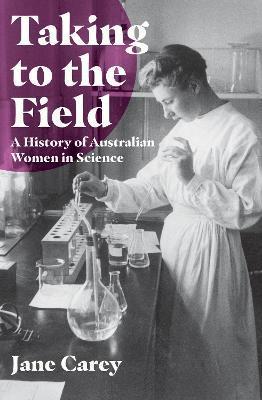
Taking to the Field: A History of Australian Women in Science
If asked to name an Australian woman scientist from the past, very few could. Let's change that. Histories of Australian science largely overlook women. Their absence gives the impression that, until recently, there were no Australian women scientists. But this is far from true: women formed a much larger proportion of the scientific community from the 1900s to the 1940s in Australia than in Britain or the United States, and numbers have only grown since. Why don't women scientists make it into history books? Because women's work is less cited than men's and more likely to be forgotten. Taking to the Field is the first comprehensive history of Australian women in science from the colonial period to contemporary times. This untold story shows that women have played a greater role than is commonly recognised. From the first years of colonisation, women engaged in myriad scientific endeavours, ranging from botany to genetics to organic chemistry. There was a vibrant culture of women in science in the years up to 1945 - as academics, researchers, lab workers, teachers, writers and activists for science-based social reform. They outnumbered men in some fields. This is not a straightforward tale of progress or a simple celebration of unsung heroines. Some women were involved in darker episodes of colonial science and eugenics. Few women of colour were given opportunities for scientific exploration. But within these limitations, many remarkable individuals illuminated our understanding of the world. From the first female science graduate, Edith Dornwell, to Nobel laureate molecular biologist Elizabeth Blackburn, Australian women have had an outsized influence. The botanical collection of Western Australian Georgina Molloy, the discoveries of Tasmanian-born molecular biologist Elizabeth Blackburn and the research of Melbourne zoologist Georgina Sweet all tell a story: how Australian women in science have transformed the world.
PRP: 201.52 Lei

Acesta este Prețul Recomandat de Producător. Prețul de vânzare al produsului este afișat mai jos.
181.37Lei
181.37Lei
201.52 LeiPrimești 181 puncte
Livrare in 2-4 saptamani
Descrierea produsului
If asked to name an Australian woman scientist from the past, very few could. Let's change that. Histories of Australian science largely overlook women. Their absence gives the impression that, until recently, there were no Australian women scientists. But this is far from true: women formed a much larger proportion of the scientific community from the 1900s to the 1940s in Australia than in Britain or the United States, and numbers have only grown since. Why don't women scientists make it into history books? Because women's work is less cited than men's and more likely to be forgotten. Taking to the Field is the first comprehensive history of Australian women in science from the colonial period to contemporary times. This untold story shows that women have played a greater role than is commonly recognised. From the first years of colonisation, women engaged in myriad scientific endeavours, ranging from botany to genetics to organic chemistry. There was a vibrant culture of women in science in the years up to 1945 - as academics, researchers, lab workers, teachers, writers and activists for science-based social reform. They outnumbered men in some fields. This is not a straightforward tale of progress or a simple celebration of unsung heroines. Some women were involved in darker episodes of colonial science and eugenics. Few women of colour were given opportunities for scientific exploration. But within these limitations, many remarkable individuals illuminated our understanding of the world. From the first female science graduate, Edith Dornwell, to Nobel laureate molecular biologist Elizabeth Blackburn, Australian women have had an outsized influence. The botanical collection of Western Australian Georgina Molloy, the discoveries of Tasmanian-born molecular biologist Elizabeth Blackburn and the research of Melbourne zoologist Georgina Sweet all tell a story: how Australian women in science have transformed the world.
Detaliile produsului



