





The Book of Wisdom of Apollonius of Tyana: Apotelesmata Apollonii
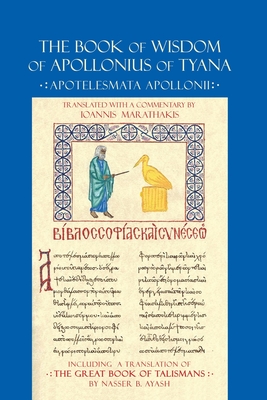
The Book of Wisdom of Apollonius of Tyana: Apotelesmata Apollonii
The Book of Wisdom is a short Greek magical text that survives in eight manuscripts, the earliest of which date to the 15th century. Although spuriously attributed to the Neopythagorean philosopher Apollonius of Tyana and dated by many scholars to the 5th, 4th or even 3rd century, it was probably composed in Constantinople in the late 12th century CE. Its sources include the Testament of Adam (an Old Testament pseudepigraph) and traditions about the telesmata of Apollonius preserved by various Byzantine chroniclers; also possibly the Picatrix, the Book of Enoch and a lost work of the Neoplatonic philosopher Proclus on Chaldean theurgy.The Book of Wisdom lists the magical names of the four seasons and the twenty-four hours; also, the different names of the sun the moon, heaven, earth and the four quarters during each season. It is said that through the power of these names one could enchant and control natural phenomena, plants, animals and even human beings, causing love or discord. Unfortunately, the descriptions of the various apotelesmata (talismans) did not survive in the Greek text, with the exception of a short fragment. But, to an extent, they can be traced in its Latin and Arabic renditions. These talismans were usually metallic statuettes with the form of the creature one seeks to control.The text first appeared in Western Europe in the early 13th century, after the sacking of Constantinople by the Crusaders in 1204, when parts of it were paraphrased in Latin as De Viginti Quattuor Horis, De Imaginibus Diei et Noctis and De Discretione Operis Differencia. These paraphrases later became the source of many other magical books, such as the Liber Lunae, the Book of Raziel, the Heptameron, the Steganographia of Trithemius and the Ars Paulina. The Book of Wisdom was also a source of the Arabic Great Book of Talismans.A fragment of the Book of Wisdom was published by the Christian Cabbalist Gilbert Gaulmin as early as 1615. It is interesting that this fragment later fell into the hands of Eliphas Levi, who used it ceremonially, in order to evoke the spirit of Apollonius. Levi included the Greek text as a supplement to the Rituel de la Haute Magie, together with an imaginative "translation".The present publication contains a detailed introduction, comparative translations of the two versions of the Book of Wisdom, a translation of the Great Book of Talismans from Paris BNF Ar. 2250 and appendices with parallel texts, including a translation of a Latin
 GRATUIT CARGUS
PRP: 141.05 Lei

Acesta este Prețul Recomandat de Producător. Prețul de vânzare al produsului este afișat mai jos.
126.95Lei
126.95Lei
141.05 LeiPrimești 126 puncte
Livrare in 2-4 saptamani
Descrierea produsului
The Book of Wisdom is a short Greek magical text that survives in eight manuscripts, the earliest of which date to the 15th century. Although spuriously attributed to the Neopythagorean philosopher Apollonius of Tyana and dated by many scholars to the 5th, 4th or even 3rd century, it was probably composed in Constantinople in the late 12th century CE. Its sources include the Testament of Adam (an Old Testament pseudepigraph) and traditions about the telesmata of Apollonius preserved by various Byzantine chroniclers; also possibly the Picatrix, the Book of Enoch and a lost work of the Neoplatonic philosopher Proclus on Chaldean theurgy.The Book of Wisdom lists the magical names of the four seasons and the twenty-four hours; also, the different names of the sun the moon, heaven, earth and the four quarters during each season. It is said that through the power of these names one could enchant and control natural phenomena, plants, animals and even human beings, causing love or discord. Unfortunately, the descriptions of the various apotelesmata (talismans) did not survive in the Greek text, with the exception of a short fragment. But, to an extent, they can be traced in its Latin and Arabic renditions. These talismans were usually metallic statuettes with the form of the creature one seeks to control.The text first appeared in Western Europe in the early 13th century, after the sacking of Constantinople by the Crusaders in 1204, when parts of it were paraphrased in Latin as De Viginti Quattuor Horis, De Imaginibus Diei et Noctis and De Discretione Operis Differencia. These paraphrases later became the source of many other magical books, such as the Liber Lunae, the Book of Raziel, the Heptameron, the Steganographia of Trithemius and the Ars Paulina. The Book of Wisdom was also a source of the Arabic Great Book of Talismans.A fragment of the Book of Wisdom was published by the Christian Cabbalist Gilbert Gaulmin as early as 1615. It is interesting that this fragment later fell into the hands of Eliphas Levi, who used it ceremonially, in order to evoke the spirit of Apollonius. Levi included the Greek text as a supplement to the Rituel de la Haute Magie, together with an imaginative "translation".The present publication contains a detailed introduction, comparative translations of the two versions of the Book of Wisdom, a translation of the Great Book of Talismans from Paris BNF Ar. 2250 and appendices with parallel texts, including a translation of a Latin
Detaliile produsului



