





The Great Schism: The History and Legacy of the Split Between the Catholic and Eastern Orthodox Churches in 1054
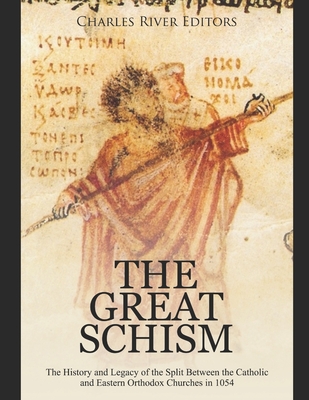
The Great Schism: The History and Legacy of the Split Between the Catholic and Eastern Orthodox Churches in 1054
*Includes pictures
*Includes excerpts of contemporary medieval sources
*Includes a bibliography for further reading
For nearly a thousand years following its foundation, there was only one Christian Church. Centered in the city of Rome, the Church expanded and grew until it became the dominant religion in Europe and beyond. The early growth of the Church had been suppressed by the Romans until the Emperor Constantine became the first to convert the empire to Christianity, and from that point forward, the growth of the Church Was inextricably linked with the Roman Empire, the most powerful military, economic, and political force in the ancient world.
For almost 600 years, from the defeat of Carthage in the Second Punic War in 201 BCE to around 395 CE, Rome was one of the most important cities in the world, but things were beginning to change around the time Constantine converted the empire. Rome controlled large areas of the world, but by the 4th century the emphasis had shifted from military conquest to the control of lucrative trade routes. The problem was that the city of Rome, isolated in the southern half of the Italian peninsula, was far from these routes, and this compelled Constantine to establish a major Roman city on the site of ancient Byzantium. The new city, Constantinople, was located on a strategic site controlling the narrow straits between the Black Sea and the Aegean, meaning it was firmly astride some of the most important trade routes in the ancient world between Europe and Asia and between the Mediterranean and the Black Sea.
Constantinople became the second most important city of the Roman Empire, thriving in parallel with Rome, but then the empire split into Eastern and Western provinces, with Constantinople the capital of the east and Rome the capital of the west. Control of trade routes made Constantinople increase in power and influence while Rome became less important.
However, not all power and influence shifted east, because one important institution remained firmly linked with the city of Rome: the Bishops of the Church. Under the rule of previous emperors, Christian Bishops had not only been formally recognized, but had been given power within the Roman state. The most important of all was "I Sommi Pontefici Romani" the supreme pontiff of Rome. The earliest holders of this title were martyrs and saints of the Church, but by the time of the rise of Constantinople, this role was elected by the other Bishop
PRP: 86.34 Lei

Acesta este Prețul Recomandat de Producător. Prețul de vânzare al produsului este afișat mai jos.
69.07Lei
69.07Lei
86.34 LeiPrimești 69 puncte
Livrare in 2-4 saptamani
Descrierea produsului
*Includes pictures
*Includes excerpts of contemporary medieval sources
*Includes a bibliography for further reading
For nearly a thousand years following its foundation, there was only one Christian Church. Centered in the city of Rome, the Church expanded and grew until it became the dominant religion in Europe and beyond. The early growth of the Church had been suppressed by the Romans until the Emperor Constantine became the first to convert the empire to Christianity, and from that point forward, the growth of the Church Was inextricably linked with the Roman Empire, the most powerful military, economic, and political force in the ancient world.
For almost 600 years, from the defeat of Carthage in the Second Punic War in 201 BCE to around 395 CE, Rome was one of the most important cities in the world, but things were beginning to change around the time Constantine converted the empire. Rome controlled large areas of the world, but by the 4th century the emphasis had shifted from military conquest to the control of lucrative trade routes. The problem was that the city of Rome, isolated in the southern half of the Italian peninsula, was far from these routes, and this compelled Constantine to establish a major Roman city on the site of ancient Byzantium. The new city, Constantinople, was located on a strategic site controlling the narrow straits between the Black Sea and the Aegean, meaning it was firmly astride some of the most important trade routes in the ancient world between Europe and Asia and between the Mediterranean and the Black Sea.
Constantinople became the second most important city of the Roman Empire, thriving in parallel with Rome, but then the empire split into Eastern and Western provinces, with Constantinople the capital of the east and Rome the capital of the west. Control of trade routes made Constantinople increase in power and influence while Rome became less important.
However, not all power and influence shifted east, because one important institution remained firmly linked with the city of Rome: the Bishops of the Church. Under the rule of previous emperors, Christian Bishops had not only been formally recognized, but had been given power within the Roman state. The most important of all was "I Sommi Pontefici Romani" the supreme pontiff of Rome. The earliest holders of this title were martyrs and saints of the Church, but by the time of the rise of Constantinople, this role was elected by the other Bishop
Detaliile produsului



