





The Ivory-billed Woodpecker: Taunting Extinction: Survival in the Modern Era
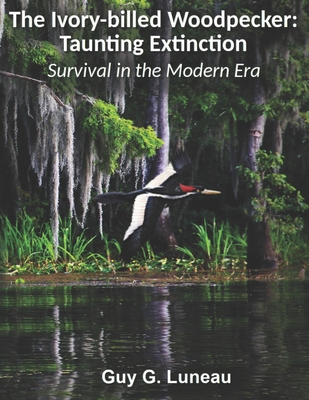
The Ivory-billed Woodpecker: Taunting Extinction: Survival in the Modern Era
This book contains the definitive evidence that the Ivory-billed Woodpecker is surviving in our modern era, two-plus decades into the 21st century.
The Ivory-billed Woodpecker, Campephilus principalis, survives on the North American continent in our modern era, two-plus decades into the 21st century. Its survival is a natural history miracle.
The ivorybill was considered by many to have gone extinct on the North American continent as far back as the early 1900's. Yet it was "rediscovered". After a short while, many lost hope and again labeled it extinct. It was rediscovered again. Sightings of the species continued on through the decades. And encounters continue up into the present day, two-plus decades into the 21st century.
How can this be? How can a large bird species, as large as a Wood Duck, continue surviving on the North American continent while living its life "under the radar" of the 330 million people residing in the USA in the 2020 A.D. time frame? This book, The Ivory-billed Woodpecker: Taunting Extinction, offers explanations of the various pathways by which this can occur -- and indeed it has occurred.
The modern-day Ivory-billed Woodpecker population is no doubt low in number. But forest square mileage is much larger today, and the average age of the trees in those forests is much older today, in the eastern USA than it was in the mid 1900's when numerous species of forest animals' populations dipped to substantially reduced numbers, including such now-abundant animals as Whitetail Deer, Wild Turkey, Wood Duck, and Black Bear to name a few. Combining the ivorybill's low, but likely increasing, population with it being a quiet, skittish-of-man, retiring, long-distance-traveling, masterfully-wily, master-of-its-environment bird species, along with a modern-day humanity who largely does not spend much time in deep forest and swamp habitats, we then have the factors of the recipe - the equation - that permits the ivorybill to elude detection by humans.
PRP: 193.36 Lei

Acesta este Prețul Recomandat de Producător. Prețul de vânzare al produsului este afișat mai jos.
174.02Lei
174.02Lei
193.36 LeiPrimești 174 puncte
Livrare in 2-4 saptamani
Descrierea produsului
This book contains the definitive evidence that the Ivory-billed Woodpecker is surviving in our modern era, two-plus decades into the 21st century.
The Ivory-billed Woodpecker, Campephilus principalis, survives on the North American continent in our modern era, two-plus decades into the 21st century. Its survival is a natural history miracle.
The ivorybill was considered by many to have gone extinct on the North American continent as far back as the early 1900's. Yet it was "rediscovered". After a short while, many lost hope and again labeled it extinct. It was rediscovered again. Sightings of the species continued on through the decades. And encounters continue up into the present day, two-plus decades into the 21st century.
How can this be? How can a large bird species, as large as a Wood Duck, continue surviving on the North American continent while living its life "under the radar" of the 330 million people residing in the USA in the 2020 A.D. time frame? This book, The Ivory-billed Woodpecker: Taunting Extinction, offers explanations of the various pathways by which this can occur -- and indeed it has occurred.
The modern-day Ivory-billed Woodpecker population is no doubt low in number. But forest square mileage is much larger today, and the average age of the trees in those forests is much older today, in the eastern USA than it was in the mid 1900's when numerous species of forest animals' populations dipped to substantially reduced numbers, including such now-abundant animals as Whitetail Deer, Wild Turkey, Wood Duck, and Black Bear to name a few. Combining the ivorybill's low, but likely increasing, population with it being a quiet, skittish-of-man, retiring, long-distance-traveling, masterfully-wily, master-of-its-environment bird species, along with a modern-day humanity who largely does not spend much time in deep forest and swamp habitats, we then have the factors of the recipe - the equation - that permits the ivorybill to elude detection by humans.
Detaliile produsului



