







The Political Theory of Possessive Individualism: Hobbes to Locke
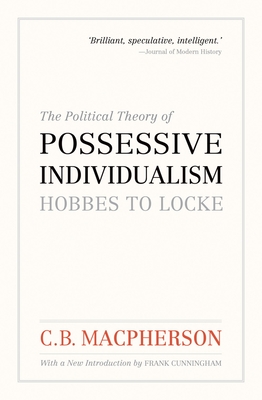
The Political Theory of Possessive Individualism: Hobbes to Locke
This seminal work by political philosopher C.B. Macpherson was first published by the Clarendon Press in 1962, and remains of key importance to the study of liberal-democratic theory half-a-century later. In it, Macpherson argues that the chief difficulty of the notion of individualism that underpins classical liberalism lies in what he calls its "possessive quality"--"its conception of the individual as essentially the proprietor of his own person or capacities, owing nothing to society for them." Under such a conception, the essence of humanity becomes freedom from dependence on the wills of others; society is little more than a system of economic relations; and political society becomes a means of safeguarding private property and the system of economic relations rooted in property. As the New Statesman declared: "It is rare for a book to change the intellectual landscape. It is even more unusual for this to happen when the subject is one that has been thoroughly investigated by generations of historians. . . Until the appearance of Professor Macpherson's book, it seemed unlikely that anything radically new could be said about so well-worn a topic. The unexpected has happened, and the shock waves are still being absorbed." A new introduction by Frank Cunningham puts the work in a twenty-first-century context.
374.30Lei
374.30Lei
Primești 374 puncte

Livrare in 2-4 saptamani
Descrierea produsului
This seminal work by political philosopher C.B. Macpherson was first published by the Clarendon Press in 1962, and remains of key importance to the study of liberal-democratic theory half-a-century later. In it, Macpherson argues that the chief difficulty of the notion of individualism that underpins classical liberalism lies in what he calls its "possessive quality"--"its conception of the individual as essentially the proprietor of his own person or capacities, owing nothing to society for them." Under such a conception, the essence of humanity becomes freedom from dependence on the wills of others; society is little more than a system of economic relations; and political society becomes a means of safeguarding private property and the system of economic relations rooted in property. As the New Statesman declared: "It is rare for a book to change the intellectual landscape. It is even more unusual for this to happen when the subject is one that has been thoroughly investigated by generations of historians. . . Until the appearance of Professor Macpherson's book, it seemed unlikely that anything radically new could be said about so well-worn a topic. The unexpected has happened, and the shock waves are still being absorbed." A new introduction by Frank Cunningham puts the work in a twenty-first-century context.
Detaliile produsului



