







The Spirit of Roman Law
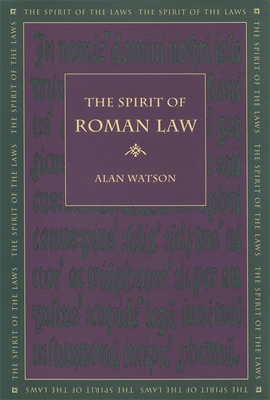
The Spirit of Roman Law
This book is not about the rules or concepts of Roman law, says Alan Watson, but about the values and approaches, explicit and implicit, of those who made the law. The scope of Watson's concerns encompasses the period from the Twelve Tables, around 451 B.C., to the end of the so-called classical period, around A.D. 235. As he discusses the issues and problems that faced the Roman legal intelligentsia, Watson also holds up Roman law as a clear, although admittedly extreme, example of law's enormous impact on society in light of society's limited input into law.
Roman private law has been the most admired and imitated system of private law in the world, but it evolved, Watson argues, as a hobby of gentlemen, albeit a hobby that carried social status. The jurists, the private individuals most responsible for legal development, were first and foremost politicians and (in the Empire) bureaucrats; their engagement with the law was primarily to win the esteem of their peers. The exclusively patrician College of Pontiffs was given a monopoly on interpretation of private law in the mid fifth century B.C. Though the College would lose its exclusivity and monopoly, interpretation of law remained one mark of a Roman gentleman. But only interpretation of the law, not conceptualization or systematization or reform, gave prestige, says Watson. Further, the jurists limited themselves to particular modes of reasoning: no arguments to a ruling could be based on morality, justice, economic welfare, or what was approved elsewhere. No praetor (one of the elected officials who controlled the courts) is famous for introducing reforms, Watson points out, and, in contrast with a nonjurist like Cicero, no jurist theorized about the nature of law. A strong characteristic of Roman law is its relative autonomy, and isolation from the rest of life. Paradoxically, this very autonomy was a key factor in the Reception of Roman Law--the assimilation of the learned Roman law as taught at the universities into the law of the individual territories of Western Europe.PRP: 343.64 Lei

Acesta este Prețul Recomandat de Producător. Prețul de vânzare al produsului este afișat mai jos.
309.28Lei
309.28Lei
343.64 LeiPrimești 309 puncte
Livrare in 2-4 saptamani
Descrierea produsului
This book is not about the rules or concepts of Roman law, says Alan Watson, but about the values and approaches, explicit and implicit, of those who made the law. The scope of Watson's concerns encompasses the period from the Twelve Tables, around 451 B.C., to the end of the so-called classical period, around A.D. 235. As he discusses the issues and problems that faced the Roman legal intelligentsia, Watson also holds up Roman law as a clear, although admittedly extreme, example of law's enormous impact on society in light of society's limited input into law.
Roman private law has been the most admired and imitated system of private law in the world, but it evolved, Watson argues, as a hobby of gentlemen, albeit a hobby that carried social status. The jurists, the private individuals most responsible for legal development, were first and foremost politicians and (in the Empire) bureaucrats; their engagement with the law was primarily to win the esteem of their peers. The exclusively patrician College of Pontiffs was given a monopoly on interpretation of private law in the mid fifth century B.C. Though the College would lose its exclusivity and monopoly, interpretation of law remained one mark of a Roman gentleman. But only interpretation of the law, not conceptualization or systematization or reform, gave prestige, says Watson. Further, the jurists limited themselves to particular modes of reasoning: no arguments to a ruling could be based on morality, justice, economic welfare, or what was approved elsewhere. No praetor (one of the elected officials who controlled the courts) is famous for introducing reforms, Watson points out, and, in contrast with a nonjurist like Cicero, no jurist theorized about the nature of law. A strong characteristic of Roman law is its relative autonomy, and isolation from the rest of life. Paradoxically, this very autonomy was a key factor in the Reception of Roman Law--the assimilation of the learned Roman law as taught at the universities into the law of the individual territories of Western Europe.Detaliile produsului



